As monsoon rains continue to lash large parts of the country, Punjab’s flood-hit regions remain in distress, while water levels are rising at major barrages in Sindh and fresh alerts have been issued for Gilgit-Baltistan and Azad Jammu and Kashmir. According to officials and local media reports, a significant number of villages in southern Punjab districts — including Rajanpur, Taunsa, D.G. Khan, Layyah, and Jhang — have been inundated, with thousands evacuated from low-lying areas. The National Disaster Management Authority (NDMA) has warned of further riverine and urban flooding due to a new wave of monsoon rains expected to persist until July 31. The overflowing Indus River wreaked havoc in Rajanpur, sweeping away crops and affecting hundreds of acres of farmland. In Taunsa and D.G. Khan, entire residential settlements including Basti Kumharan, Basti Mangotha, and Basti Sahbe Wala were submerged following a breach in a protective bund built by the National Highway Authority (NHA) near the Layyah-Taunsa bridge. Though the bridge itself remains intact, nearby villages are reportedly underwater, forcing residents to evacuate to safer ground. District authorities confirmed that hundreds of residents from Bait Ashraf and Jardh Laghari villages in Taunsa have been left homeless, awaiting relief and government assistance after their homes and connecting roads were swallowed by the floodwaters.
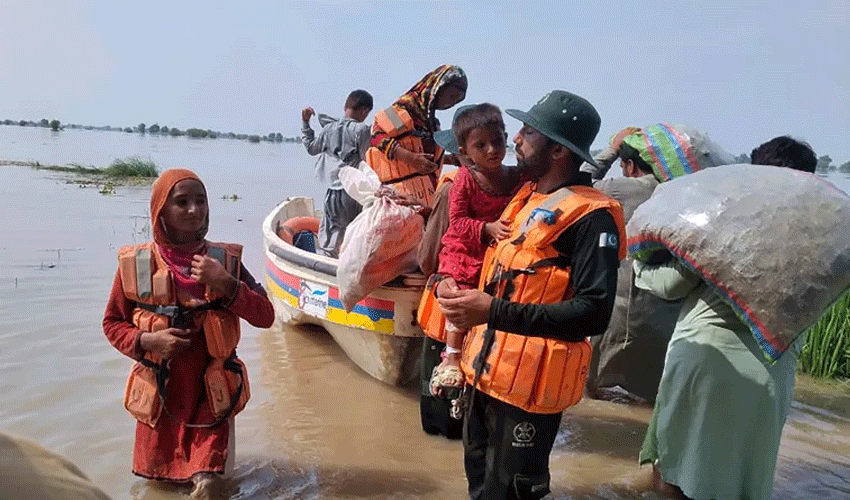
In Jhang, over 10 villages were inundated by the rising Chenab River, damaging standing crops and rural infrastructure. A similar situation was observed in Hafizabad, where the Chenab's erosion submerged vast agricultural tracts. Officials said rainwater has accumulated in the Sukhike region for over 10 days without adequate drainage. In Dera Ghazi Khan, a low-level flood was recorded at Taunsa Barrage on the Indus River, with an inflow of 331,915 cusecs and an outflow of 320,415 cusecs. Deputy Commissioner Usman Khalid, during a visit to the flood-prone areas of Kot Chatta and Malkanai Kalan, said the water level was gradually decreasing and that the situation remained under control. “We are closely monitoring the Indus River and all emergency arrangements have been completed,” he said. While no individuals are currently staying in flood relief camps, the district administration has assured preparedness for any emergency situation. In Rajanpur, the Rood Kohi (hill torrent) flood disaster continues to wreak havoc. Settlements like Basti Faqir Bakhsh, Basti Mahesar, Pati Juma Arain, Sonwah, and Chak Jalalpur remain particularly vulnerable. Every year, residents in these areas suffer losses to homes, crops, and connectivity. Incomplete embankments along the Sem Nallah have allowed the Kohi river to overflow into nearby villages, cutting them off from urban centers and stranding residents without relief access. Locals have repeatedly urged the government to complete protective infrastructure in the flood belt to avoid annual devastation.
Sindh braces for rising floodwaters
In Sindh, moderate to low-level floods continue at the Guddu and Sukkur barrages, with a significant increase in water levels recorded over the past 24 hours. At Guddu Barrage, the inflow reached 423,000 cusecs with an outflow of 387,000 cusecs, while Sukkur Barrage saw inflows of 360,000 cusecs and outflows of 388,000 cusecs. Water levels at Guddu, Sukkur, and Kotri are expected to rise further within the next 24 hours, and the NDMA has advised downstream districts to remain on alert.
Gilgit-Baltistan: Chilas-Naran highway reopens; search for missing tourists continues
In Gilgit, the National Highway Authority (NHA) has reopened the Chilas-Naran Highway for traffic from Zero Point, restoring a key route for transport. However, the search operation for seven missing tourists — including a private TV anchor and members of her family — remains underway. Two of the missing individuals are from Nankana Sahib. Disaster management authorities, the Tourist Police, and Rescue 1122 teams are continuing their operations amid difficult terrain.
NDMA issues national flood alert; death toll rises to 281
The National Disaster Management Authority (NDMA) has confirmed two additional deaths due to rain-related incidents in the past 24 hours, bringing the nationwide death toll since June 26 to 281, with 675 individuals reported injured. In its latest advisory, the NDMA issued a flood warning for Gilgit-Baltistan and Azad Kashmir, forecasting heavy rains from July 28 to 31 in Gilgit, Skardu, Hunza, Shigar, Muzaffarabad, Neelum Valley, and Bagh. The possibility of riverine flooding, urban inundation, and landslides remains high due to sustained precipitation. The Chitral River and its tributaries are also expected to swell owing to a combination of rainfall and snowmelt in the upper regions. All relevant federal and provincial institutions have been directed to prepare emergency response plans, ensure the availability of relief equipment, and maintain clear communication channels for timely evacuation and rescue operations.